At a Glance
Keyword Matching
- Looks for exact word matches
- No contextual understanding
- Requires manual synonym setup
- High false positive rate
- Constant maintenance needed
Semantic Matching
- Understands meaning and context
- Recognizes skill relationships
- Automatic synonym recognition
- Context-aware analysis
- Minimal configuration required
Real-World Examples
| Resume Says | Job Requires | Keyword | Semantic |
|---|---|---|---|
| "Led a team of developers" | "people management" | No Match | Match |
| "Built REST APIs using Python" | "web services development" | No Match | Match |
| "5 years coding in JavaScript" | "JS experience" | No Match | Match |
Semantic matching understands context. Keyword matching only sees exact words.
Detailed Comparison
| Aspect | Keyword Matching | Semantic Matching |
|---|---|---|
| How It Works | Searches for exact or partial word matches | Analyzes meaning and context of content |
| Synonym Recognition | Requires manual configuration for each synonym | Automatically understands related terms |
| Context Understanding | No understanding of skill relationships | Recognizes how skills relate to each other |
| False Positives | High—matches words regardless of context | Low—understands intended meaning |
| Setup Time | Requires extensive keyword list creation | Minimal—upload job description and start |
| Maintenance | Ongoing keyword list updates needed | Self-adapting to new terminology |
How Semantic Matching Works
Semantic matching uses natural language processing (NLP) to understand the meaning behind text, not just the words themselves. When analyzing a resume, it considers:
- •Context: How skills and experience relate to the job requirements
- •Relationships: That React implies JavaScript knowledge, or that leading teams indicates management capability
- •Equivalents: That 'ML' and 'Machine Learning' refer to the same skill
- •Relevance: Which experiences matter most for the specific role
Why This Matters for Recruiting
Candidates describe their experience in countless ways. Two developers with identical skills might write completely different resumes. One says "developed microservices architecture," another says "built distributed backend systems." Keyword filtering might miss one. Semantic matching recognizes both as relevant.
This means fewer qualified candidates slipping through the cracks, and more accurate shortlists that reflect actual job fit—not just resume optimization skills.
See Semantic Analysis in Action
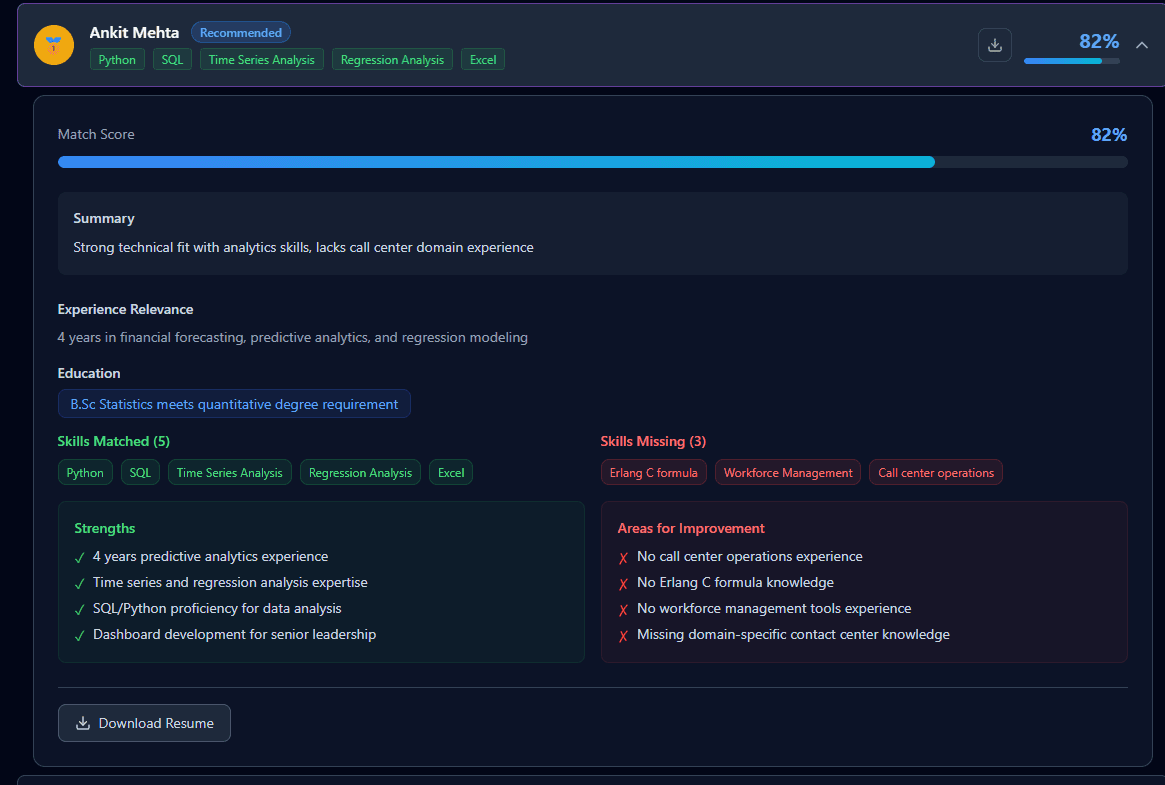
Context-Aware Candidate Analysis
Semantic matching goes beyond keywords to understand the full picture of each candidate's qualifications and how they align with your requirements.
Semantic Matching Advantages
Understands Intent
Semantic matching recognizes that 'led cross-functional initiatives' demonstrates leadership, even without the word 'manager' in the resume.
Recognizes Skill Layers
A candidate with React experience is understood to have JavaScript skills. Semantic matching grasps these inherent relationships.
Connects Related Concepts
Project management, program management, and product management are distinct but related. Semantic matching understands the nuances.
Keyword Matching Limitations
Exact Match Dependency
If a resume says 'client relations' but you search for 'customer service,' there's no match—even though they describe similar skills.
Context Blindness
A resume mentioning 'no experience with Python' would still match a search for 'Python experience.' Keywords can't distinguish context.
Configuration Burden
Every variation, synonym, and alternative phrasing must be manually added to keyword lists. This requires constant maintenance.
The Bottom Line
Keyword matching is like searching for a needle in a haystack by looking for things shaped like needles. Semantic matching understands what a needle is and finds it regardless of shape. For resume screening, this means finding qualified candidates who describe their experience differently than you expected—without maintaining exhaustive keyword lists.