At a Glance
AI Resume Screening
- Semantic understanding of content
- Context-aware skill matching
- Ranked candidate scores
- Minimal setup required
- Recognizes skill synonyms
Traditional ATS Filtering
- Keyword-based matching
- No contextual understanding
- Binary pass/fail results
- Requires keyword configuration
- Misses alternative phrasings
Detailed Comparison
| Feature | AI Screening | ATS Filtering |
|---|---|---|
| Matching Method | Semantic understanding of skills, experience, and context | Keyword matching based on exact or partial word matches |
| Context Awareness | Understands relationship between skills and job requirements | No contextual understanding—matches words in isolation |
| Synonym Recognition | Recognizes related terms (e.g., 'ML' = 'Machine Learning') | Requires exact keyword configuration for variations |
| Ranked Results | Provides match scores for prioritization | Binary pass/fail filtering |
| Setup Complexity | Upload job description and resumes—minimal configuration | Requires keyword rules and boolean query setup |
| Integration | Standalone tool or can complement existing ATS | Part of broader HR system with candidate tracking |
How AI Resume Screening Works
AI resume screening uses natural language processing (NLP) to understand the content of resumes and job descriptions. Instead of looking for exact keyword matches, it analyzes the semantic meaning—understanding that "project management experience" is relevant when a job description asks for "team lead capabilities."
This semantic approach means AI can identify qualified candidates even when they describe their experience using different terminology. A developer who writes "built REST APIs" is recognized as having the same skill as one who writes "developed web services," even though the keywords are completely different.
Traditional ATS Limitations
Traditional ATS systems filter resumes based on keyword presence. Recruiters configure boolean queries like "Python AND Django AND 5+ years" to screen candidates. While effective for basic filtering, this approach has significant limitations:
- •Candidates using synonyms get filtered out (e.g., "coding" vs "programming")
- •No understanding of skill relationships (e.g., React implies JavaScript knowledge)
- •Requires ongoing maintenance of keyword lists
- •Binary filtering doesn't help prioritize candidates
See Semantic Matching in Action
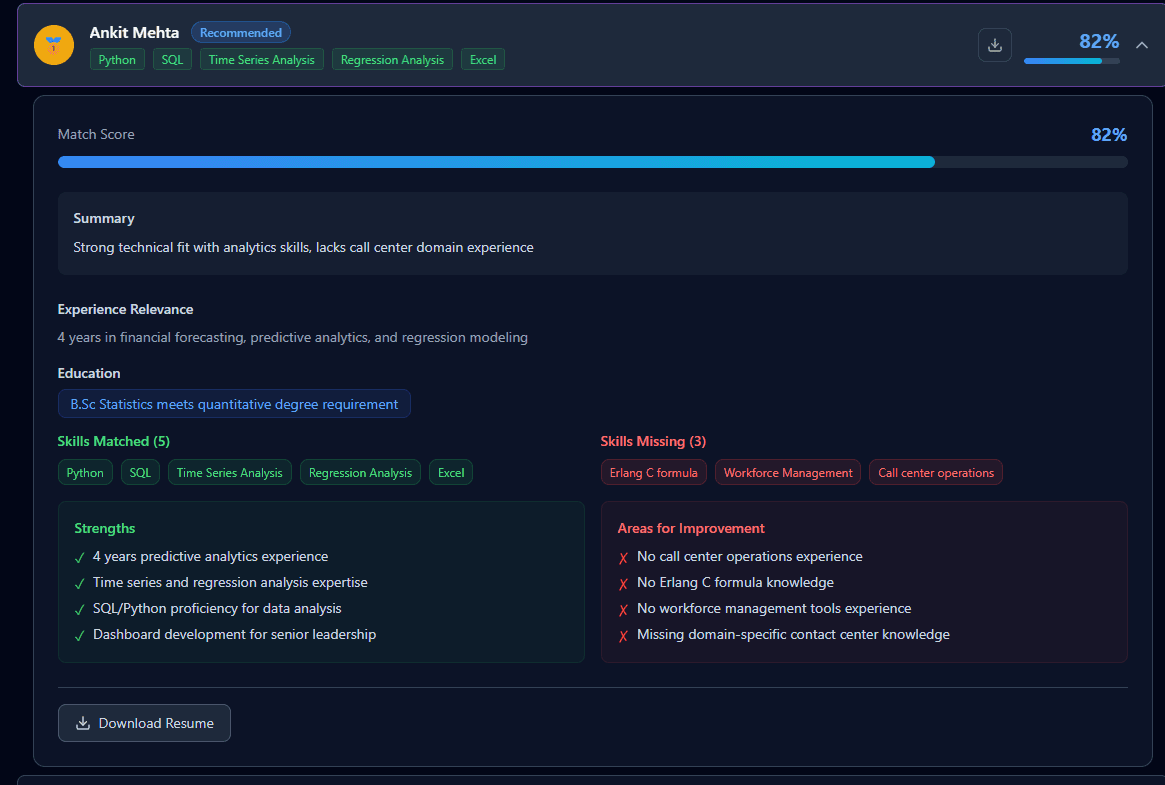
AI Understands Context, Not Just Keywords
AI analysis recognizes related skills and experience, providing a comprehensive view of each candidate's qualifications beyond simple keyword presence.
AI Screening Advantages
Semantic Understanding
AI comprehends the meaning behind text, not just the words. A candidate with 'team leadership' experience is recognized even if the job description asks for 'people management.'
Accurate Matching
Context-aware analysis reduces false negatives. Qualified candidates aren't rejected because they used different terminology for the same skills.
Faster Shortlisting
Get ranked results in minutes. AI processes resumes against job requirements without manual keyword configuration.
ATS Filtering Limitations
Keyword Dependency
ATS filters rely on exact or partial keyword matches. Candidates who use synonyms or alternative phrasing get filtered out unfairly.
False Negatives
Qualified candidates often get rejected because their resume doesn't contain specific keywords, even when they have the required skills.
Configuration Overhead
Setting up effective ATS filters requires ongoing maintenance of keyword lists and boolean queries for each position.
The Bottom Line
AI resume screening and ATS filtering serve different purposes. ATS systems excel at candidate tracking and workflow management. AI screening excels at understanding candidate qualifications. The best approach often combines both—using AI for initial screening and ranking, then managing shortlisted candidates through your existing ATS.